Today, we're introducing Monarch 2, our latest open-source large language model, developed by Africa Compute Fund for people and institutions working on complex problems that require deeper understanding, stronger reasoning and better access to knowledge.
Monarch 2 is a general-purpose AI model with a particular emphasis on economic, institutional and development knowledge, including African economies, languages and contexts. It brings together language understanding, reasoning, coding, mathematical capabilities and multilingual support for research, professional work and everyday problem-solving.
Built for real work
Economic research and analysis
Explore economic indicators, analyze development trends, compare countries and regions, interpret statistical data and investigate relationships between growth, trade, employment, investment and public policy.
Investment and business intelligence
Research companies and industries, analyze financial information, evaluate commercial opportunities, prepare investment reports and examine markets.
Government and institutional work
Analyze policy documents, review legislation, summarize lengthy reports, support strategic planning and make institutional knowledge easier to access and use.
Scientific research and engineering
Explore scientific literature, investigate technical questions, work through mathematical problems, develop software and analyze research findings.
Multilingual applications
Build applications that understand and generate content across languages, including African languages. The training programme includes dedicated evaluations in languages often underrepresented in large-scale AI development.
Software development and automation
Write, explain, debug and review code; work with technical documentation; create applications; and integrate AI capabilities into existing workflows.
Training and evaluation
The latest Monarch 2 training programme focused on multilingual understanding, economic and development knowledge, mathematical reasoning, coding and tool-oriented capabilities.
The nine-billion-parameter adaptation was evaluated on 1,885 independently held-out examples across 18 language, domain and technical categories. Held-out language-modeling loss decreased in every measured category. Separate answer-level assessments also showed improvements on World Development Indicators questions and a Swahili general-knowledge benchmark.
Economic and development knowledge
The World Development Indicators (WDI), maintained by the World Bank, are a comprehensive collection of internationally comparable development statistics. They cover economic growth and productivity; employment and poverty; health, education and population; energy and infrastructure; agriculture, climate and the environment; trade, investment, public finance and debt.
Working with this material requires more than recognizing economic terms. Questions can depend on countries, dates, units, growth rates, shares of GDP, per-capita measures and historical comparisons.
In a held-out evaluation of 125 WDI questions, exact-answer accuracy increased from 51.2% to 85.6%. That represents 107 correct answers instead of 64—a gain of 34.4 percentage points. The assessment tested answers to a defined set of source-grounded development questions.
African languages and multilingual capabilities
The adaptation was evaluated across 11 languages: Amharic, Hausa, Igbo, Somali, Swahili, Xhosa, Yoruba, Zulu, English, French and Portuguese.
All 11 showed lower held-out language-modeling loss. Across the eight African languages, the measured reductions were Hausa 40.7%, Amharic 37.3%, Somali 29.2%, Igbo 27.4%, Zulu 26.2%, Xhosa 23.0%, Swahili 18.1% and Yoruba 17.6%.
The evaluation also recorded reductions for Portuguese (41.7%), English (35.6%) and French (30.7%).
On a separate 13,937-question Swahili MMMLU multiple-choice evaluation, accuracy rose from 43.37% to 49.54%, corresponding to 859 additional correct answers.
Mathematics, coding and technical capabilities
The held-out training evaluations recorded lower language-modeling loss in tool calling (65.3%), STEM (28.0%), coding (25.9%), mathematics (22.6%) and verified mathematical reasoning (19.7%). These measurements evaluate predictive performance on matched technical examples, rather than task-level coding accuracy.
Broader general-purpose capabilities
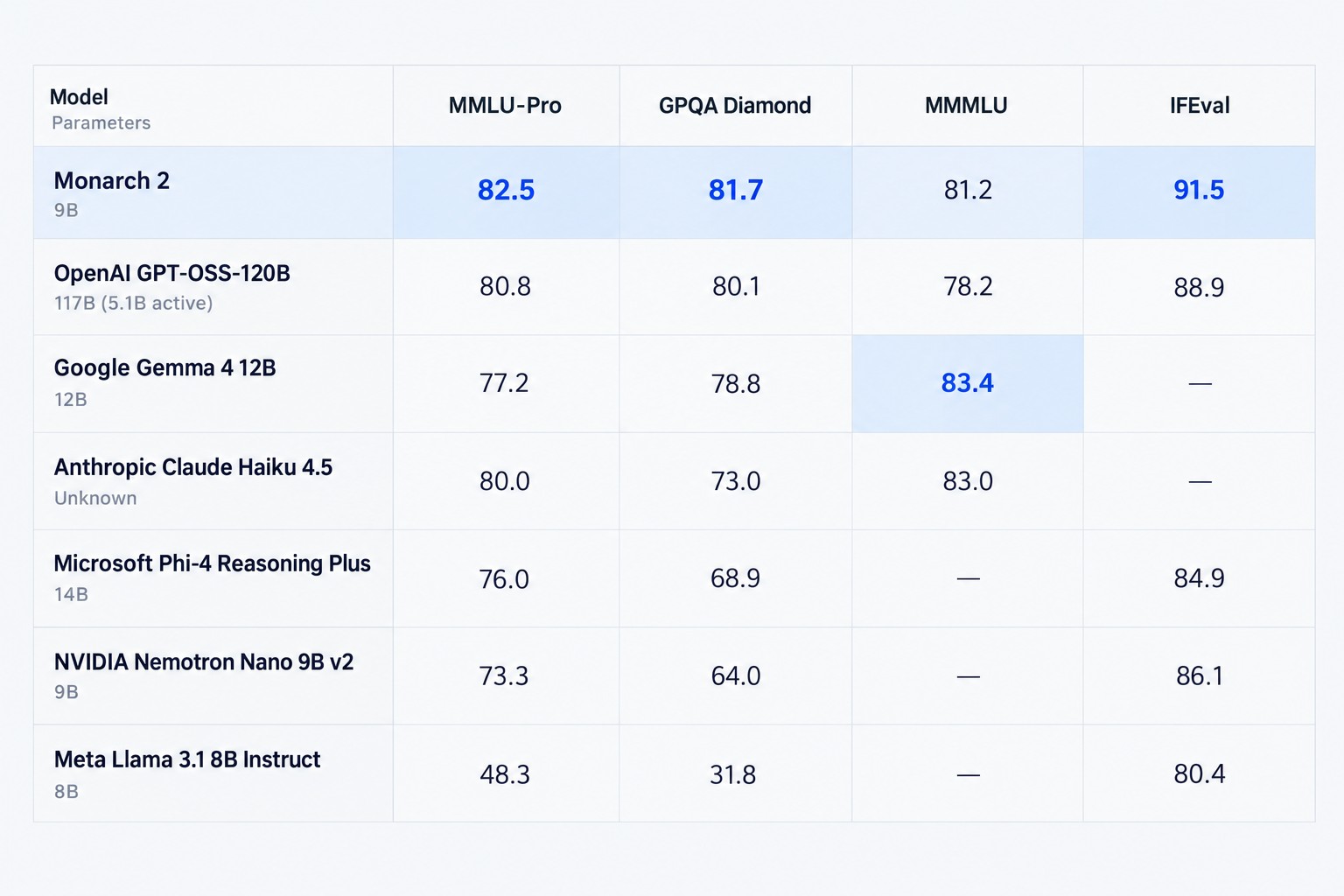
Monarch 2 is part of a wider model and application platform covering knowledge-intensive work, reasoning, instruction following, programming and multilingual tasks. The following general-purpose benchmark graphic reproduces published scores for its underlying 9B foundation, not results from the independently evaluated adaptation. It is included as context alongside the original adaptation measurements above.